Showing posts with label Mid Century Modernism. Show all posts

Saturday, November 1, 2014

Sotto Voce Miami


Ray Bradbury's envisions

...of a distant hereafter that can be triggered by this Illustrated Man building, an all-nighter teller of astounding stories of betrayal, cruelty, transpiration and shattered sounds of shaky galleons anchored at the humid coastline of the Malecon, with Don Facundo Bacardi standing between hallucinations of better times…

It’s not just that, is also declaring a vertiginous future with a myriad of images. Open scares with an incontrollable voice of hope. 

Latin modernism at its best! 
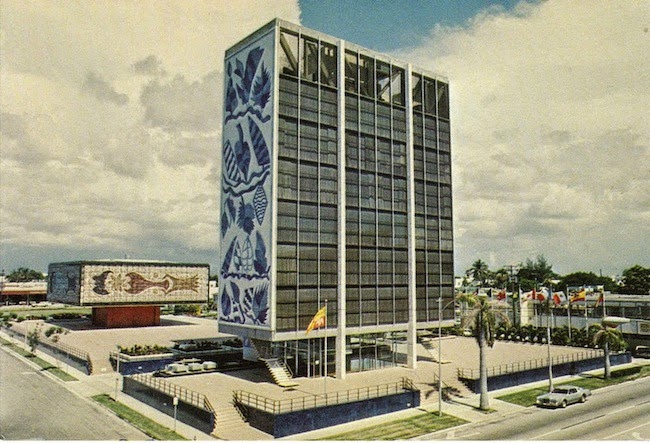

The Bacardi Buildings in 1975

The Bacardi Buildings
Biscayne Boulevard at NE 20th. Terrace
Midtown Miami.

The 8-story tower was designed in 1963 by Cuban architect Enrique Gutierrez, who previously worked on Bacardi’s headquarters in Mexico City.

Miami's iconic Bacardi Building and  the adjacent Jewel Box (designed by local architect Ignacio Carrera-Justiz in 1975) were declared historic sites by the Miami Historic and Environmental Preservation Board on Oct 6, 2009 and  are a landmark of Midtown Miami. 

On April 18, 2012, the American Institute of Architects' Florida Chapter placed the building on its list of Florida Architecture: 100 Years. 100 Places, as Bacardi USA.

© Luigi Seta


Recommended reading: Bacardi and the Long Fight for Cuba: The Biography of a Cause
By Tom Gjelten

Saturday, July 26, 2008

LEARNING FROM KITSCH LAND

I remember being a young and romantic student of architecture and coming upon the just published masterpiece book of Architect Robert Venturi called "Learning from Las Vegas". To be quite honest I felt a mixed sentiment of both surprise and aversion. How could the art and the architecture of the "ugly and ordinary" be a matter of such study? What a terrible blow to we, the designers, on our spirited crusade for the dictatorship of the good taste!

Should we now be forced to join the Bad Taste Unlimited Incorporated, run by the governors of kitsch? At the time, the thought made me tremble!

So what exactly is kitsch?

Is kitsch the enemy of good design? Is it “bad art”?... Or maybe it’s a functional part of what is accepted today as “high art”?

The concept of kitsch became widely accepted during the second half of the 20th century, though the origin of the term is more complex. Kitsch came to us from Germany, its precise origin obscure, with many suspecting Yiddish input (a known wink from the shtetl.)

Kitsch is pretense…Yet not all pretense is kitsch. Something more, something involving you, the recipient of the sentiment, is required to create the sense of the intrusion (the unwanted hand on the knee) which kitsch achieves all so well! For kitsch is not just pretending, it is asking you to pretend along with it.

And touché! There is the revolutionary side of this movement!

Kitsch is an attempt to have the spirit of life… but on the cheap - a function of its irony. Often the sentimentalism or mawkishness it presents is an impudent invitation to deeply explore forgotten places inside ourselves. Therefore its value is in the kind of relationship it proposes, and precisely why some objects of design will appeal to the kitsch condition within every one of us: because we all , at sometime or other, envisage only the pleasant – refusing to see the unacceptable and tragic, both valid, if unfortunate, part of our lives.

So now you begin to see that there really are no kitsch objects, only a kitsch relationship; an intimate, unreal, and overly sentimental depiction of life which becomes an affair between the object and its receiver.

That is kitsch.

For the Modernist, ornamentation was a crime. Therefore, during much of the 20th century, decoration was considered a taboo when it came to furniture design. In the1920’s,“modern” design principles dictated that the “form follow function”, so any ornamentation was considered frivolous and unacceptable in good design.

Until the arrival of the Pop Art in the 1950’s, kitsch has pejorative connotations. It then associated with the society of consumption…and soon began to appear in the depiction of common, everyday things. In this field is where kitsch found its real authenticity.

George Nelson, the exceptional industrial designer for Herman Miller, was also one of the most influential personalities in U.S. design during that period. His work concer
ned himself with ongoing sociological and artistic themes and his “Marshmallow Sofa” is the perfect example of mid-century kitsch. A traditional sofa transformed into a three-dimensional structure of art, the Marshmallow Sofa is made of soft, round, colored cushions which can be removed and replaced to improve wear and tear, the Marshmallow Sofa must surely be considered on of the earliest Pop Art furniture design, if not the quintessential design icon of mid-century furniture.

Of course not even this icon of kitsch design made its entry into our culture so easily. The 1956 Herman Miller furniture read: "Despite its astonishing appearance, this piece is very comfortable", the company revealed a notable complex of guilt for this transgression to the modernist asceticism!

In the 1970s, kitsch expression gained a more respectful position, existing alongside accepted modernist styles. “Queen Anne”, the chair designed by Venturi, is a postmodern blending of these styles. Based on a chair designed circa 1790, its surface is decorated by playfully floral motif from a favorite tablecloth, imposed over diagonal stripes copied from the paintings of the artist Jasper Johns.
Such traditional floral patterns can be quite sentimental and thus antithetical to the modernist aesthetic. However, it is this very quality of sentimentality that appealed to Postmodernist Architects in their search for conventional images and patterns for use in a novel new way.

To rise above that which is merely bad, kitsch must have the quality of excess and a force of passion; it must have an energy manifesting itself in color, decoration or sheer blatant tackiness. Why some designs come to be regarded as kitsch depends upon the way in which they clash with the more established notions of good taste. But are those notions real? You decide.


So, in closing, my friends, I remind you that kitsch is as old as the sun and everywhere around us.

From time to time, allow yourself to be part of its kitchen and sink drama!

Benvenue l'art pour vivre!